Showing posts with label decomposers. Show all posts
Thursday, February 28, 2013
Recycling in the Rainforest
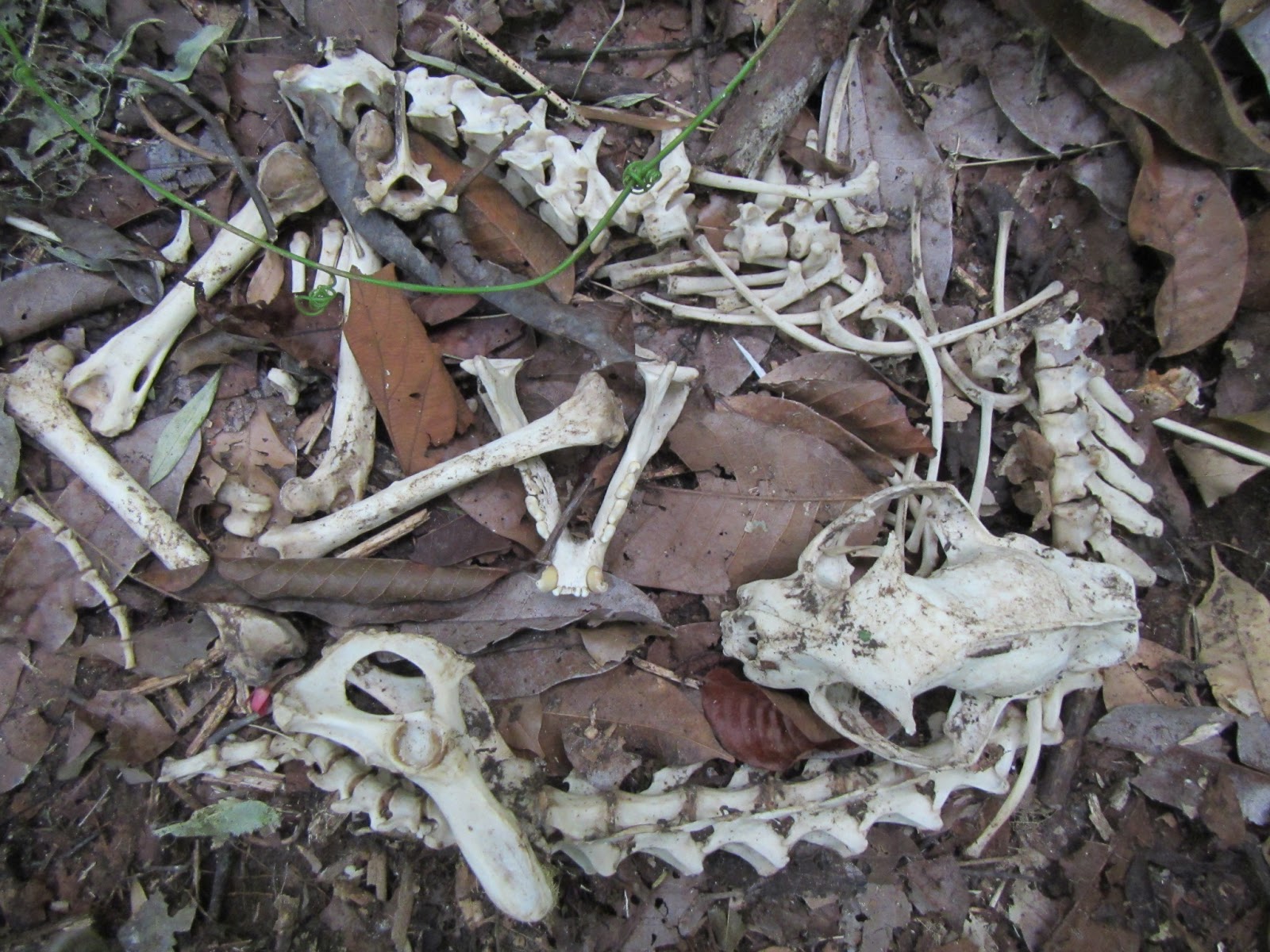
While hiking in the forest, my friends Jackie and Erika came upon this intact skeleton of an ocelot. There are so many organisms on BCI that are decomposers that it only takes a few weeks for the remains of a dead animal to be recycled. Many animals, large and small, benefit from another animal’s demise. Turkey vultures (very large birds) might be first on the scene, followed by smaller creatures and finally the microscopic decomposers arrive to finish the decomposition process. This is Mother Nature’s way of reusing and recycling nutrients.
Finding a skeleton also allows scientists to study lifestyle and eating habits of this ocelot. Jackie was surprised when she looked inside its mouth and found several missing or broken teeth, especially the important large canines that ocelots use to catch their prey and the carnassal teeth that are used for tearing their food like a pair scissors. Notice in the photo that the eye sockets are both in the front of the skull. This is a good indication that this predator had good stereoscopic vision.
- Fran Zakutansky
Labels:
bci,
decomposers,
Fran Zakutansky,
skeleton
Location:
Barro Colorado Island, Panama
Saturday, February 23, 2013
Recycling in the Forest
| "Leaf litter" in the forest |
Decomposers are a vital link in any ecosystem, especially in a tropical forest, where soil nutrients are scarce. When a plant or animal dies, it is important for their nutrients to be recycled quickly so they are available to other plants and animals. This photo shows fallen dead leaves blanketing the forest floor. The “leaf litter” would be so thick in no time in a lush tropical forest with many trees if they were not constantly being decomposed.
| Termite nest |
The big lump on the tree in this photo is a termite nest. Termites are social insects that live together in large colonies. They decompose dead trees (wood) with the help of mutualistic protozoans (microscopic single-celled organisms that live in their digestive systems). Termites help decompose the wood so its nutrients can be recycled.
| Fungi on fallen tree |
The last photo shows a tree trunk that has died and fallen down. Notice that the wood is well on its way to being decomposed completely and the white bracket fungi attached to the tree help the process along.
So, you know the saying: REDUCE, REUSE, AND RECYCLE! This is especially true in the rainforest.
- Fran Zakutansky
Labels:
bci,
decomposers,
Fran Zakutansky,
fungi,
recycling,
termites
Location:
Barro Colorado Island, Panama
Subscribe to:
Posts (Atom)