Showing posts with label bci. Show all posts

Thursday, March 6, 2014

We Move Slowly, But Really, We Are Not Lazy!


Two toed sloth

There are 2 types of sloths on this rainforest island in the Panama Canal.  You can easily tell them apart by their coloration and how many claws they have on their front legs.  Sloths dig their long sharp claws into a branch to hold on while they are hanging upside down in the canopy layer of the rainforest.  Three-toed sloths have the slowest digestive rate of all mammals and they also have a very slow metabolism.  Sloths live in a mutualistic situation with algae and moths. Both of these live in sloth fur.  The algae supplies both green camouflage coloration and a food source for the sloth who scrapes the algae off its fur with its claws and eats it.  The algae benefits by having a constant supply of water and exposure to some sunshine for photosynthesis.   

Three toed sloth
Fur of the three-toed sloth is adapted for holding rainwater in crosswise grooves.  Moths also live in sloth fur.  These moths require that the three-toed sloth come down to the ground to poop.  Mother moths from the sloth lay their eggs on the sloth poop and the larvae hatch on the poop and eat it.  When the larvae go through metamorphosis and become adults, the adults fly back into the sloth fur.  Moths supply a necessary element (nitrogen) to sloths and sloths make it possible for moths to complete their life cycle.  This is another example of mutualism. 

If you want to read more about sloths, here are four interesting links for you:


- Fran Zakutansky

Bats Make Their Own Tents


I should have looked underneath this leaf after I took this photo.  Although it is pretty low to the ground for bats, the two sets of V-shaped notches in the leaf look a lot like how tent-making bats chew leaves to make a nice tent shelter for themselves.  I wonder if there were bats sleeping underneath this leaf.  Tent-making bats chew notches in leaves so that the leaves will form an upside-down V (much like a simple tent).  They sleep underneath the leaf in the V, which makes it difficult for predators to find them.  It also protects them from rain.  I would normally expect to find leaves used by tent-making bats to be six or more feet off the ground.


I put 2 red circles around bats in this photo who are sleeping in a leaf tent that they made by notching the leaves on this tall tree (photo taken by Selina Ruzi).  The next time that I hike on this trail, I will have to investigate further so I can determine if tent-making bats used this leaf as their tent. 

- Fran Zakutansky

They’re Bees, But They Don’t Sting


I was not too worried about getting close to these stingless bees to take the video that you see here.  I found out after I got pretty close that although they don’t sting, they can bite.  If you get too close to their nest, some species of stingless bees fly into your hair and get tangled and bite your scalp.  I was lucky this time and from now on, I will give them a little more distance.

They choose old, hollow logs and their nests are easy to spot because of the white “front entrance” that they build.  The bees that you see hovering around the “front entrance” in this video are the guards and are called angelistas.  Guards, workers, and the queen are all females.  Like other bees, stingless bees are social insects, meaning that they live in colonies and each bee in the colony has a special job to do (division of labor).  The workers leave the nest (you can see them leaving in the video) to collect pollen and nectar.  They may also collect oils and waxes from plants and hair from animal burrows to use in their nest construction.  When the workers return to the nest, they communicate with other workers about the location of the food supply.  Bees are important pollinators for plants.

Thanks to Meghan Duell, an entomologist studying stingless bees in Panama, for her helpful input for this blog entry. 

- Fran Zakutansky

Tuesday, March 4, 2014

What Foods Do Anteaters Eat?


I heard some leaves rustling outside my room on BCI (the island research field station that I’m living on for 2 weeks). I usually look outside to see an agouti when I hear rustling. If you want to learn more about agoutis and see a photo, scroll all the way back in this blog to February 19, 2013. This time, it was not an agouti; it was a tamandua (anteater).


The anteater was looking for a nice ant colony that it could rip open with its strong front claws. Then it would use its long tongue (the tongue can be one foot long) to lap up hundreds of ants. Tamandua snouts are thin and tube-like, which makes it easy for them to poke their heads into ant colonies. Anteaters also eat termites the same way by scratching open their nests with their strong front claws and using their tongue to lap out the termites. The tamandua is one of my favorite rainforest animals because it looks like it is wearing a dark vest over its tan fur.

Click here if you would like more information on tamanduas.
Here is another photo of a tamandua.

- Fran Zakutansky

Monday, March 3, 2014

Going Batty


Sometimes you don’t even have to walk into the rainforest at this incredible research field station on BCI in Panama to see wildlife.  Bats hang out (literally) on the outside walls of my room every day.  They are always gone when I come back from dinner because it’s dark out by then and they are nocturnal.  Bats are mammals like us.   They have much longer finger bones than we do, and they have a thin membrane of skin between the bones so they can fly. 

Take a look at the size of the bat’s eyes in this video.  Many nocturnal animals have very large eyes so they can see well in the dark.  This bat’s eyes are small.  Bats use echolocation to determine where they are going and to catch their food.  They send out sound waves that bounce off objects and then return to the bat. From this, bats can determine the size and shape of objects that they are approaching.

Very few species of bats are harmful to humans (for example, vampire bats may bite us).  Most bats, like the ones in the video are actually helpful to us because every night they eat hundreds of insects, like mosquitoes that are pests to us. 

There are many different species of bats on this research island and scientists come from all over the world to study these bats. I guess you realize by now that these scientists (called chiropterologists) sleep during the day and do their field work at night.  I’m glad that my roommate here is an entomologist because she works with her ants during the daytime so she and I have a similar schedule.

Click here for a lot more detailed scientific information on BCI bats: http://www.montclair.edu/csam/prism/rainforest-connection/panama/mammal-directory/bats/

- Fran Zakutansky

Saturday, March 1, 2014

Extreme Teamwork - Army Ants


Army ants are social insects, living in very large colonies up to half a million ants.  You definitely want to be sure that you do not step on a row of army ants marching across the trail.  They attack prey in huge numbers (as many as 100,000 simultaneously). They slice the prey with their scissor-like mandibles and they spread a dissolving acid on it, which digests the prey’s body so the ants can slurp it up.   After watching this video and seeing how large the soldier ants’ mandibles are, you can see why you would not want to have them crawling up your hiking boots and into your socks.  By the way, in this army, the soldiers are all females…And so are all of the workers….And so is the queen. 

Social insects show teamwork and division of labor and army ants are a prime example of predatory teamwork.  Army ants teach us that “there is strength in numbers”. 

- Fran Zakutansky

Friday, February 28, 2014

OUCH, What Big Spines You Have!

I was leisurely strolling thru the rainforest this afternoon, watching fireflies (lightning bugs) blink on and off and listening to the howler monkeys howl.  It’s a good thing that I was watching where I was walking because I came very close to this black palm tree trunk covered with long, black spines. 


These spines would definitely pierce through my field pants and maybe even my hiking boots.  I’m sure that I would get a nasty infection if some of these spines broke off in my skin.  It reminded me that I always need to look around when I’m hiking in the rainforest to avoid dangers.  These spines are a defense mechanism for the black palm to protect its fruit and seeds. If I were a rainforest animal who eats seeds, I would definitely think twice before scurrying up this tree trunk to get some yummy seeds. 


Notice in this other photo that Dr. Jackie Willis took that this monkey seems to be sitting very close to the spines of this black palm tree while eating its fruits.  I guess, in this case the fruits were just so enticing, that the monkey was willing to take his chances with the spines.  I know that I will stay as far away from any black palm trunks that I see on future rainforest hikes!

- Fran Zakutansky

Wednesday, February 26, 2014

Poison Dart Frog


I am back in the beautiful rainforest on Barro Colorado Island, in the middle of Lake Gatun, in the Panama Canal.  Go to google maps and search for “Panama Canal, Panama”.  Find Barro Colorado Island in the middle of Lake Gatun.  Zoom way in (in the Satellite view) and you will see the only buildings on the island are in a cove along the eastern shore.  That is where I am living for the next 2 weeks.  Now, zoom out and notice that the rest of the island is all green, lush, beautiful tropical rainforest.  Scientists from all over the world come to this island to study all kinds of plants and animals. 

Even though we are in the middle of the dry season, here, in February, there are still some streams and wet areas.  That is exactly where I saw this poison dart frog this morning as I was hiking near a small stream. Frogs are amphibians and have thin skin that needs to be kept moist.  So, if you are looking for frogs, look near a stream.

Many frogs have camouflage coloration, making it difficult to see them in their environment because they blend in well.  Take a look at the pretty coloration of this little frog, who is only about the size of a nickel.  This frog produces toxins (poisons) in its skin.  Its bright coloration warns predators that this frog will not make a tasty meal (this is called aposematic coloration and is the opposite of camouflage).

Poison dart frogs got their names because there are a few species whose skin is very toxic and natives rubbed the tips of their blow darts on the frog’s skin to help them catch their dinner out in the forest.

I know there are other colors of poison dart frogs, but so far this is the only color that I have seen on BCI.

- Fran Zakutansky

Saturday, March 9, 2013

Night Symphony

Chirp, creak, hum, buzz, screech.  Whoever said the forest is a quiet, peaceful place has never tried to fall asleep on BCI.  In a room enveloped by trees the raucous symphony playing outside our windows often makes sleep elusive.   As soon as the lights go out, the night swells with the music of a congregation of astonishing new voices.

Creeping from the forest’s silhouette, the night brings out a new cast of players.

Every inch of the forest is alive and the more intently I listen, the more life I hear.  Buzzing insects; screeching bats, tiny chirping tungara frogs; mammals rustling in the leaves on the forest floor; the whispered wing beats of night birds.  Even the robust hammering of rain pellets against my roof, and the ticks, snaps, and thuds of distant branches falling to the ground or on the roofs of buildings, fill the night with their steamy melody.

Of the 120 mammal species found on BCI, it’s the 72 species of bats that rule the night.

Everything moves.  Everything breathes.  Everything is animated with music and energy.  Listen long enough and the weary trekker, nestled in the cocoon of her bed, begins to appreciate the lullaby of the always-awake jungle symphony. 

- Katrina Macht

Thursday, February 28, 2013

Recycling in the Rainforest


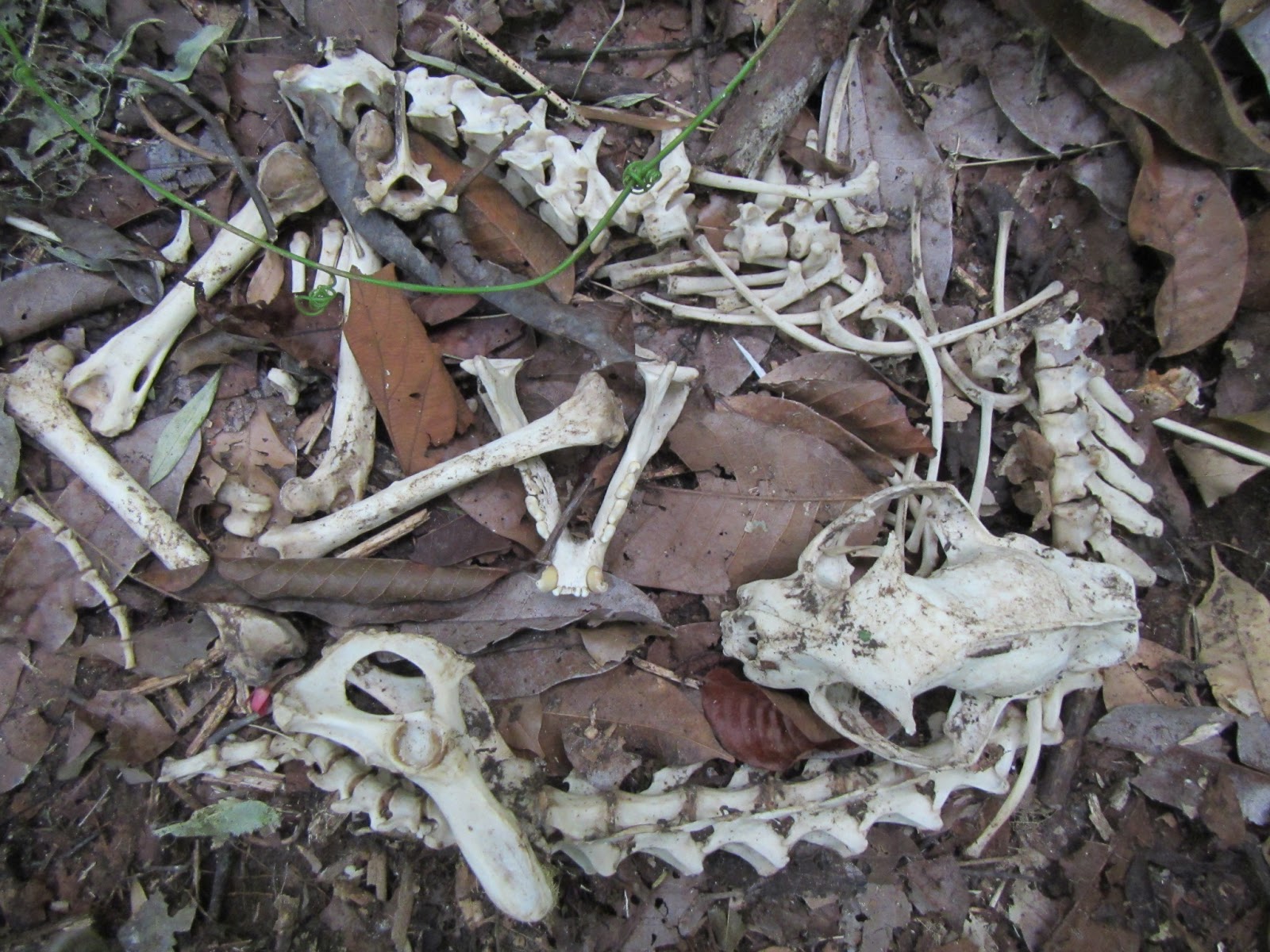
While hiking in the forest, my friends Jackie and Erika came upon this intact skeleton of an ocelot.  There are so many organisms on BCI that are decomposers that it only takes a few weeks for the remains of a dead animal to be recycled.  Many animals, large and small, benefit from another animal’s demise.  Turkey vultures (very large birds) might be first on the scene, followed by smaller creatures and finally the microscopic decomposers arrive to finish the decomposition process.  This is Mother Nature’s way of reusing and recycling nutrients. 

Finding a skeleton also allows scientists to study lifestyle and eating habits of this ocelot.  Jackie was surprised when she looked inside its mouth and found several missing or broken teeth, especially the important large canines that ocelots use to catch their prey and the carnassal teeth that are used for tearing their food like a pair scissors.  Notice in the photo that the eye sockets are both in the front of the skull.  This is a good indication that this predator had good stereoscopic vision.

- Fran Zakutansky

Wednesday, February 27, 2013

Perfect Camouflage - Both Shape and Coloration

As we walked home from dinner last night, my friend, Anna spotted this strange creature hanging from the white railing along the path.  This is the largest walking stick that I have ever seen!  Five of its legs are holding on to the railing, the sixth leg is dangling off to the right.  Having six legs is one of the characteristics that tells you that this animal is an insect. Its head is right next to the tip of Anna’s middle finger and its long tail is hanging straight down.

Thank goodness this walking stick decided to hang out on the railing rather than in a tree.  We never would have spotted it in a tree!  Notice that it is shaped like a thin branch of a tree and it also has the perfect mottled coloration to look like a twig or branch.  Nature creates well-adapted creatures for survival and this is one of my favorites!

- Fran Zakutansky

Frog on a Raft

Frog on a raft

I was out walking in the rainforest and came up to a shallow pond.  As I looked carefully in the pond, I saw thousands of cute little tadpoles swimming around.  As I walked around the pond, I saw the coolest thing.  It looked like a white foam raft about the size of the palm of my hand and sitting pretty on top of the raft was a very small, but adorable frog.  Take a look at the photo.  The frogs make this foam raft by kicking their feet in the water as they release a liquid.  The mother (female) frog lays her eggs into the middle of the raft.

The floating raft is a good adaptation to protect the eggs from hungry predators, prevents them from dehydrating, and protects them from parasites and bacteria.  It’s convenient that the eggs hatch into tadpoles right in the water where the tadpoles swim.  After the tadpoles hatch, the foam disintegrates (it is biodegradable).  After a few weeks, the tadpoles start growing legs and lose their tails and become adult frogs and they look like the frog in the photo perching on top of the foam.

- Fran Zakutansky

Monday, February 25, 2013

Jaws and Claws

Every year when I travel to Barro Colorado Island one specific theme emerges amidst all the astonishing sights and sounds of the forest.

The story begins at boat docks of Barro Colorado Island.
The year of the trogon, the year of the monkey, the year of the tamandua.  This is definitely the year of the crocodile.  I should have known that crocs were going to take center stage when the first animal I saw stepping off the boat was a small mama stretched out on the lake bank, catching the last of the sun’s rays.  My one-woman welcoming committee.

Little Mama Crocodile is quite the welcoming committee.

But “Little Mama” in no way prepared me for what was to come.  Of course I already know crocodiles are mighty predators, and since hunting them was banned in 2000, their numbers have increased exponentially.  I also know this is nesting season for both crocs and iguanas, which doesn’t bode well for the iguanas.  Still no amount of prior knowledge prepared me for what I was about to witness.  A once-in-a-lifetime predation event – at least once in my lifetime.

It all began unceremoniously enough.  As I was relaxing on the balcony of one of the laboratory buildings after a late afternoon hike in the forest, I spied a hefty crocodile near the boat docks on the opposite side of a mesh fence constructed around the perimeter of this part of the island.  We’ll call her Bertha, and Bertha was one big, bad, mean and ugly looking crocodile.

Duuun dun duuun dun dun dun dun dun dun dun…
Just a few meters away, on the ramp leading down to the boat docks, was a solitary iguana, seemingly unaware that a flimsy fence was all that stood between her and certain death.  We’ll call her Iggy.

Innocent Iggy prior to the incident.

I hadn’t yet seen any iguanas this visit and was eager to capture a photo of her.  Stealthily, I crept down the sidewalk leading to the docks, digitally memorializing the moments with every step I took.  Inching my way closer and closer to Iggy, Bertha suddenly shot straight up in the air, seizing a totally different iguana on her side of the fence.  As she rose up I saw Iggy’s cousin hanging out from either side of her jaws before she dove into the lake with her new found prey.
One less iguana on the banks of BCI.
Everything happened so fast; I thought Bertha was coming over that fence for sure and either Iggy or I were goners.  What a total surprise to see in her grasp an iguana I never knew was there.

Diving into the lake to enjoy a tasty late afternoon iguana snack. 
Iggy looked “all shook up.”  After Bertha disappeared into the water she cautiously leaned over the far side of the dock ramp, peering into the water below.

What just happened here?
About that same time I heard a rustle in the leaves at the water’s edge and saw two or three more iguanas hustling up the stalks of the Heliconia, trying to get as high up and as far away from Bertha as they could. 

One iguana sacrificed so the others can live and nest another day. 

Big Bertha remains a formidable force of which to be wary.

- Katrina Macht

Saturday, February 23, 2013

Look at those leaves

There are over 300 different types (species) of trees on this small island called Barro Colorado Island (it’s less than 3 miles across), located in the middle of the Panama Canal. 

Cecropia tree

The tree in this photo (Cecropia) has very distinctive lobed leaves.  Can you count how many lobes each leaf has?  Cecropia flowers and leaves are favorite food of kinkajous. 

Kinkajou Photo Source:   www.bite.ca (Photo of the Month:Kinkajou)

Kinkajous are very cute tan furry nocturnal mammals with big eyes, but I would not want a kinkajou as a pet because they like to sleep during the day and stay up at night!

- Fran Zakutansky

Antlion

Antlion Pits
As I was coming back to my home (for the next week, anyway), I saw many little ditches in the dry, sandy dirt near my door.  They were different sizes, but all perfectly formed.  These must be antlion pits (see photo).  The antlion is the larval (baby) form of a lacewing insect.  They are sometimes called doodlebugs because of the designs that they make in the sandy soil as they are looking for a good place to dig their pit).  An antlion looks a like a chubby pillbug with giant pincher jaws.  The antlion uses these massive pinchers to toss sand from the bottom of its pit (sandy ditch) to make the walls so steep that when an ant steps just over the edge of the pit, it slides down the sandy wall and right into the waiting jaws of the antlion.


Take a look at this cross-section photo (from dk images) of an antlion who just captured an ant in its pit. When this happens, the antlion kicks a spout of sand from the bottom of the pit. 

You can see the antlion at work in this video. Look carefully to see its giant jaws doing the digging and tossing. As antlions grow larger, they make larger pits. I bet when I return tomorrow that pit will be all repaired and the antlion will be at the bottom, with jaws protruding, waiting for its next meal.


- Fran Zakutansky

Tarzan would love this forest


As I walk through the dense tropical forest here on BCI, an island in the Panama Canal, very little sunlight reaches the ground because there are so many leaves above catching the rays for photosynthesis.  Plants and trees race to grow tall quickly so they can get above the canopy to the top emergent layer of the forest where sun is plentiful.

Vines are masters of growing quickly to reach the sun because instead of building their own sturdy base and trunk, they grow on tree trunks to reach the precious sunlight.  There are hundreds of different types of vines here. Some are thin with delicate green leaves and others are thick and woody and can be so strong that they actually strangle and kill their host tree.  And you know that some vines are strong enough that Tarzan and Jane could swing on them.


What a great adaptation for reaching the high forest layer quickly by using their precious energy to grow quickly rather than needing to grow wide and sturdy.

- Fran Zakutansky

A real, live Toucan Sam


I cannot believe how beautiful this tropical forest island is.  We are in the middle of a lake in the Panama Canal.  I’m sitting on my balcony as I type this and a toucan is sitting on a tree right in front of me.  I think he is looking at me as much as I’m looking at him.  You can’t miss a toucan-it’s the “Froot Loops Bird”.  His beak looks so large, it almost looks like he might topple forward, but his beak is very lightweight.  He uses this large beak to yank nuts, seeds, and berries off of a tree and then he tosses his head backwards to swallow his food whole.  Like many other birds, the fruit seeds pass through the toucan’s digestive system unharmed and seeds are spread when the bird releases (poops) them far from where he ate the fruit.  He is such a colorful bird!

- Fran Zakutansky

Hangin’ Around

Alarm clock—I don’t need one in the rainforest.  Every morning before dawn (usually around 5:30 AM), howler monkeys are letting us know they are waking up.  I am always surprised that a monkey that only weighs about 12 pounds can make such a loud, deep howl.


Here is what my early morning alarm clock sounds like.  Howlers also howl when they’ve chosen their nighttime sleeping spot (to tell other howler troops to stay away), when it starts raining (maybe they don’t like getting wet), and male howlers howl to keep other males away. 

Howler monkeys have prehensile tails.  This means that they can use their tails to hold on to branches; a very convenient feature to have in the forest.  The first part of this video shows a howler hanging by its tail so its hands are free to eat the juicy fruits from the tree.  The second half of the video gives you a very good look at the howler’s face and hands.  Maybe an appropriate title for this video should be, “does anyone have a napkin that I may use?”

- Fran Zakutansky

Scientists study plants and animals in the forest


I am spending 2 weeks living on a beautiful island (BCI) in the Panama Canal.  The plants and animals are protected and scientists come from all over the world to study them.  The scientists all meet in the dining hall for a delicious dinner after collecting data out in the forest all day.  They discuss what they saw during their field work and sometimes they help each other by discussing questions that arise.  Some scientists stay a few weeks, some stay a few months.

Many return every year to continue their research.  As you walk along the forest trails, you can see how some of the botanists mark their plants and trees so they can be sure that they study the same tree all the time.  See photos that show some of the scientists’ tags that I saw while hiking in the tropical forest.

One scientist has been studying mammals (and doing a mammal census) every year for over 30 years.  She has remote cameras lashed to trees along the trail and when an animal passes by the camera, the camera takes a photo or video.  She has photos of tapirs, ocelots, and pumas that are almost impossible for scientists to see because they are so shy and so well-camouflaged.

- Fran Zakutansky

Recycling in the Forest

"Leaf litter" in the forest

Decomposers are a vital link in any ecosystem, especially in a tropical forest, where soil nutrients are scarce.  When a plant or animal dies, it is important for their nutrients to be recycled quickly so they are available to other plants and animals.  This photo shows fallen dead leaves blanketing the forest floor.  The “leaf litter” would be so thick in no time in a lush tropical forest with many trees if they were not constantly being decomposed.

Termite nest

The big lump on the tree in this photo is a termite nest.  Termites are social insects that live together in large colonies.  They decompose dead trees (wood) with the help of mutualistic protozoans (microscopic single-celled organisms that live in their digestive systems).  Termites help decompose the wood so its nutrients can be recycled.

Fungi on fallen tree

The last photo shows a tree trunk that has died and fallen down.  Notice that the wood is well on its way to being decomposed completely and the white bracket fungi attached to the tree help the process along.

So, you know the saying: REDUCE, REUSE, AND RECYCLE!  This is especially true in the rainforest.

- Fran Zakutansky